When Forests Become Data: Who Controls the Value?
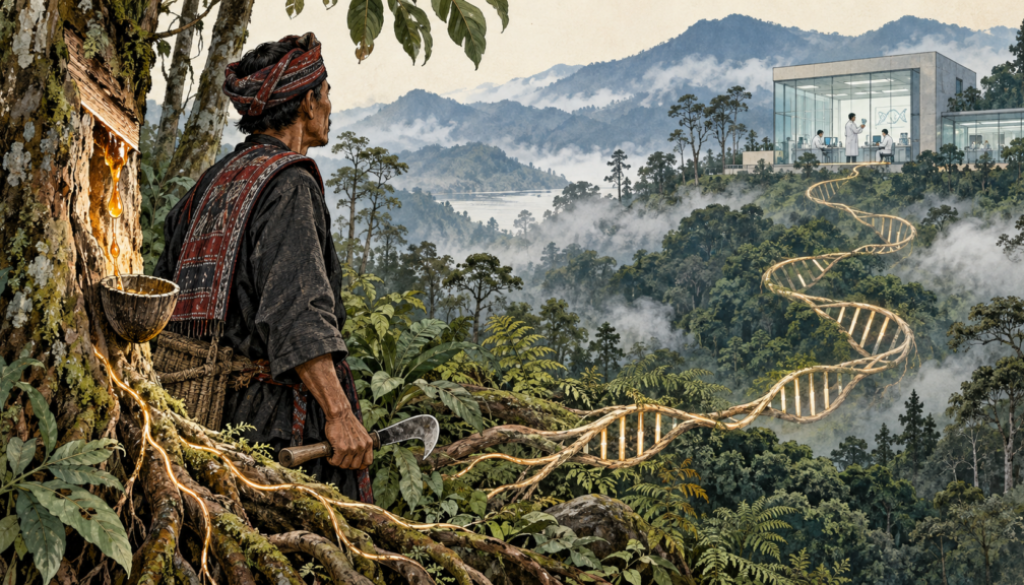
In North Sumatra, benzoin trees cared for by Batak communities now stand near genomics laboratories and international research networks. The question is not only what science can discover, but who will control the data and its value.
By Barita News Lumbanbatu | Hariara Institute | Environment, Indigenous Peoples, Science
A drop of benzoin resin falls from a tree in Pollung. For Batak farmers, the resin pays for food, school fees and daily needs. For a laboratory, the same tree may hold something that is easier to move and harder to see: genetic data.
Once a machine reads a plant’s DNA, the information can be copied, stored, studied and sent across borders. It can support conservation and medical research. It can also become part of a scientific paper, a patent or a valuable commercial product. Who decides how that information is used? What should return to the people who have protected the trees and carried knowledge about them for generations?
These questions are becoming urgent at the Herbal and Horticultural Science and Technology Park, known as TSTH2, in Humbang Hasundutan regency, North Sumatra. The roughly 500-hectare research complex has grown into a center for plant research, processing, training and international cooperation, including partnerships with Chinese institutions.
A small bridge leads to a larger question
A tapping knife hangs from Ama Jelita Lumbangaol’s waist as he walks through TSTH2. Research buildings stand on one side. On the other lies the benzoin forest where his family has worked for decades.
He stops at a wooden bridge over a narrow stream. The place was once only a footpath. Lumbangaol built the bridge so farmers could cross the water while collecting resin.
“I built this bridge so farmers could cross the river to collect benzoin resin.”
For local people, a benzoin forest is not empty land. It is a workplace, a classroom and a living inheritance. Mongabay reported in 2022 that some resin harvesters said construction of the research center had pushed them from their working areas. Others said they had to pass security posts to reach trees they had long managed.
The laboratories are now operating. Their success cannot be measured only by buildings completed, plants studied or products developed. It must also be measured by a basic question: do the people who cared for this landscape still have access, a voice and real bargaining power?
When benzoin becomes code
Indonesia has more than 30,000 plant species. Around 9,600 are known to have economic or practical uses, according to the Ministry of Health’s policy agency. This biological wealth makes research on medicinal plants highly promising.
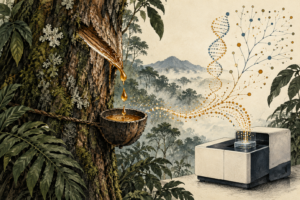
Genomics is the study of all the genetic information inside a living organism. In simple terms, researchers read the “instruction book” inside a plant’s cells. They can compare plant populations, look for useful traits, guide conservation and speed up research for medicine or agriculture.
Scientific partnerships can bring better equipment, training, research networks and opportunities for Indonesia to develop products instead of exporting only raw materials. But when a plant becomes data, geography matters less. A physical sample may remain in Indonesia while its genetic information is stored and used elsewhere.
Indonesia and China have expanded cooperation on medicinal plants since 2020. An AidData project record describes an agreement to establish a center for medicinal-plant conservation, research and innovation, involving China’s National Development and Reform Commission and Zhejiang University.
In November 2022, BGI Group signed memorandums of understanding with Indonesia’s Ministry of Health, the University of Indonesia and the Del Institute of Technology, or IT Del. IT Del said the cooperation covered a genomic sequencing and storage platform and the digitization of Indonesia’s unique germplasm. In April 2026, IT Del also signed an agreement with the Hainan branch of China’s Institute of Medicinal Plant Development to plan a joint laboratory. Proposed work includes germplasm conservation, genomic analysis, the extraction of active compounds and product development involving jernang and agarwood.
Yet the public announcements reviewed for this article do not clearly explain where genetic data will be stored, who may access or reuse it, whether samples may leave Indonesia, how intellectual property will be divided, or how communities will share in any benefits.
This lack of public information does not prove that safeguards are absent from unpublished contracts. It does mean that communities and independent researchers cannot judge whether the arrangements are fair.
The knowledge existed before the laboratory
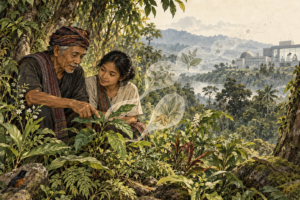
Several hours from Pollung, Efron Simanjuntak walks through a forest in Bona Ni Dolok village, North Tapanuli. He stops beside a plant and picks one of its leaves.
Local people call the plant pirdot. Efron’s family boils its leaves as a traditional drink for coughs, fever and colds. He also points to sanduduk, traditionally boiled for stomach pain. These are community practices, not proof that the treatments have been confirmed through clinical trials.
Efron learned from his parents, who received the knowledge from earlier generations. Knowledge about plants does not begin when a sample enters a laboratory. It grows from a long relationship among people, forests, language, work and memory.
“The people who have safeguarded this knowledge for generations were never genuinely involved from the beginning,” said Samuel Raimondo Purba of the Indigenous Peoples Alliance of the Archipelago, or AMAN.
Samuel said projects involving Indigenous lands, resources and knowledge should follow the principle of free, prior and informed consent. Consent should be given without pressure, sought before decisions are made, and based on complete information that communities can understand.
Benefits must be more than a promise
Genetic resources and related traditional knowledge are also covered by the Nagoya Protocol, a global biodiversity agreement that calls for fair benefit-sharing. Indonesia and China are parties to the protocol. But an international agreement does not automatically create justice on the ground. The central questions remain: who sits at the negotiating table, and who sets the terms?
“Local communities are not merely people affected by development. They are knowledge holders,” said Avena Matondang, an anthropologist at the University of North Sumatra.
Meaningful participation requires more than a consultation meeting. Communities could help choose which plants are studied, set conditions for collecting samples, decide how knowledge and data may be reused, and negotiate how benefits will be shared.
| What must be open | Questions that must be answered |
| Samples | Which plants are collected, where do they come from, and who gave permission? |
| Data | Where is genetic data stored, who can access it, and for what purpose? |
| Rights | Who owns research results, publications, patents or products? |
| Benefits | What returns to communities: income, jobs, training, recognition or support for forest protection? |
| Oversight | Who ensures that agreements are followed, and how can communities object? |
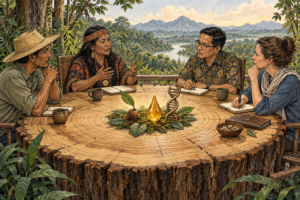
Benefits do not have to mean money alone. Communities could be recognized as research partners, named in publications, employed in research, trained in new skills, supported to manage their own databases and forests, or given a share of commercial revenue. The form of benefit must be negotiated with them, not decided after the research is already underway.
Without these protections, an old extractive relationship may return in a new form. In the past, outsiders removed timber, resin or minerals. Today, what moves may be information taken from genes and traditional knowledge.
The real test for Indonesian herbal research
As mist settles over Pollung, Ama Jelita Lumbangaol stands between two worlds. Behind him are laboratories able to read DNA. Ahead are trees holding knowledge that existed long before those technologies arrived.
Indonesia needs science, modern research facilities and international cooperation. But progress cannot be measured only by how quickly a machine reads a genome or how many products reach the market.
The real test is simpler and harder: will innovation be built with the people who protected the forest, or will it turn their inheritance into value controlled by others?