
Lake Toba Community Turns Water Hyacinth Into Fertilizer, Jobs, and Hope
By Kai Ingot Damai Siallagan
Edited by Hariara Institute
SAMOSIR, Lake Toba– At first glance, water hyacinth looks harmless.
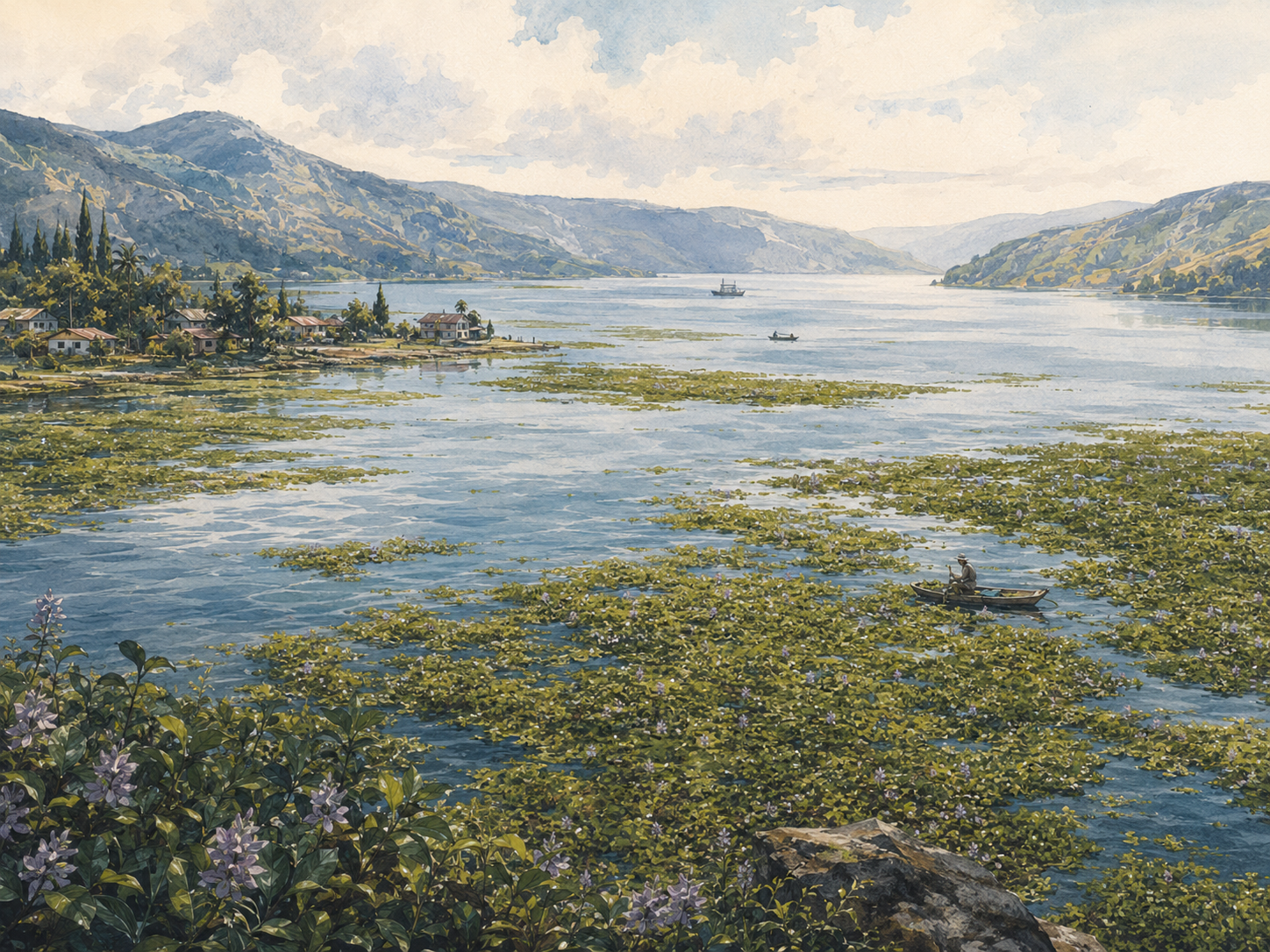
Its green leaves float quietly on the surface of Lake Toba. Purple flowers sometimes make the plant look beautiful. But beneath the green carpet, the lake may be losing sunlight, oxygen, and space for native life.
For communities living around Lake Toba in North Sumatra, Indonesia, the spread of water hyacinth is more than an environmental problem.
It can block fishing routes, disturb boats, damage fish habitats, trap waste, and reduce water quality. It may also show that too many nutrients, chemicals, and pollutants are entering the lake.
In September 2024, a grassroots initiative decided not to wait for a perfect government program.
The initiative is called Basmi Eceng Gondok, or BEG, which means “Eradicate Water Hyacinth.”
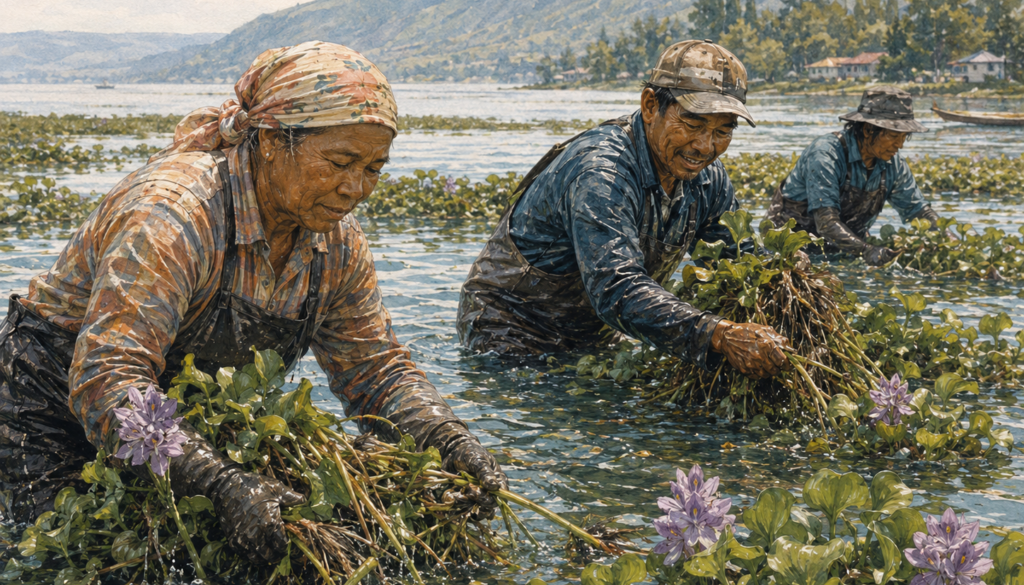
Led by Sidabutar, BEG removes the invasive plants from Lake Toba and turns them into organic fertilizer for local farmers.
“We are not only cleaning the lake,” Sidabutar said. “We are creating something useful for the community.”
The idea is simple: take a plant that threatens the lake and transform it into something that can help farmers.
But behind that simple idea is difficult, dangerous, and exhausting work.
Eleven Workers Fighting a Fast-Growing Plant
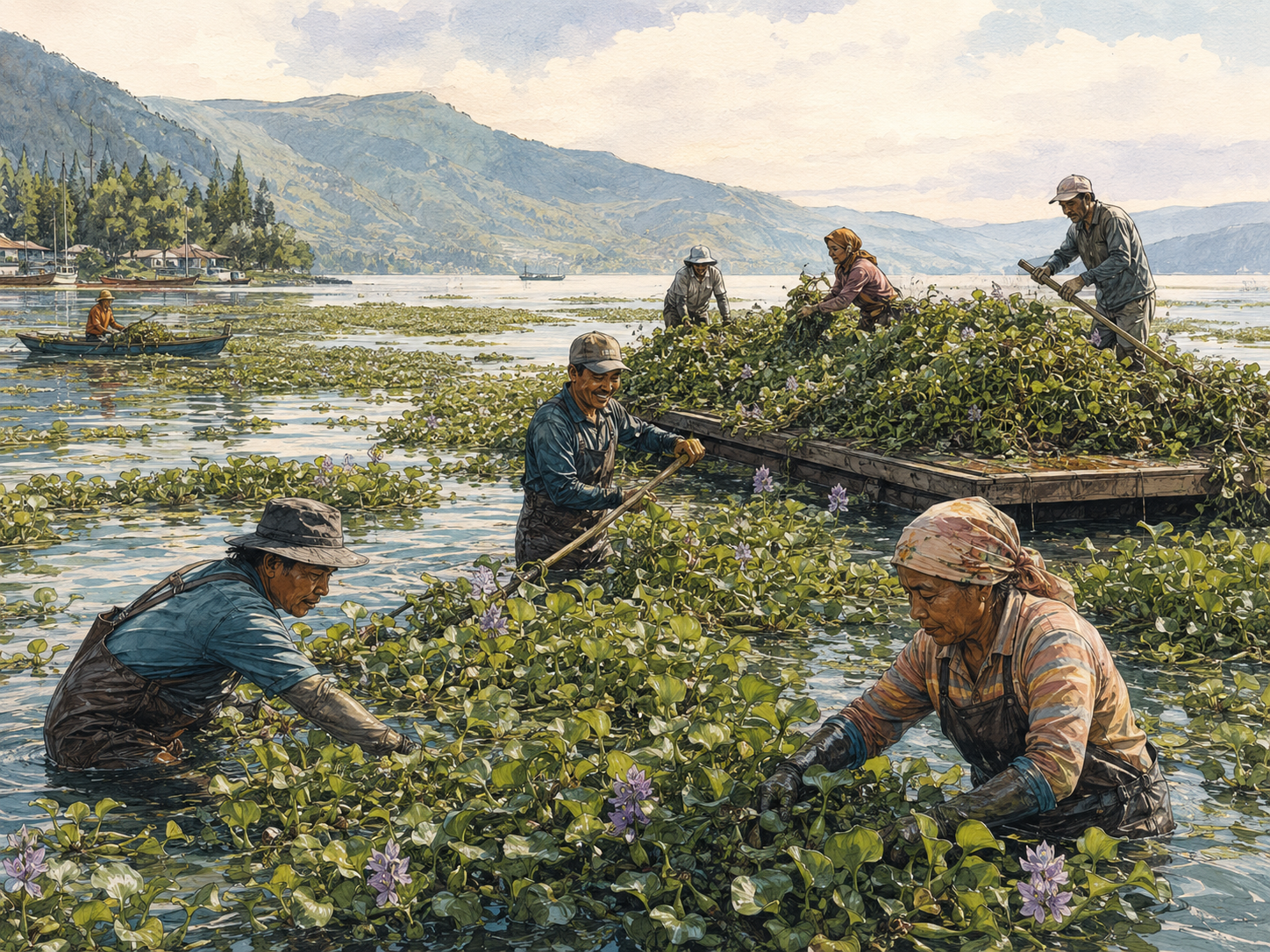
BEG operates with a team of 11 workers.
Each day, the workers enter the water and pull out thick groups of water hyacinth by hand.
The plants are heavy because they contain large amounts of water. Workers must lift them onto simple floating platforms before moving them to land.
They often work in mud and polluted water.
Their skin is exposed to mosquitoes, leeches, insects, and changing weather. Without proper machines or safety equipment, the work can be risky.
Still, the workers continue.
During its first four months, BEG cleared around 1.25 hectares, or more than three acres, of water covered by water hyacinth.
The initiative also produced and distributed more than 6,000 sacks of organic fertilizer.
According to BEG, the fertilizer helped farmers save nearly 367 million rupiah, or approximately US$22,500, in farming costs.
The program also created employment for people who previously did not have stable work.
In one movement, BEG is trying to solve three problems at once: an invasive plant threatening Lake Toba, high fertilizer costs for farmers, and limited employment opportunities for local communities.
The results show that local environmental action can create both ecological and economic value.
Why Water Hyacinth Spreads So Quickly
Water hyacinth is one of the fastest-growing aquatic plants in the world.
It often spreads rapidly in water that contains high levels of nitrogen and phosphorus.
These nutrients can enter lakes through household sewage, livestock waste, agricultural fertilizer, tourism activities, poorly managed rubbish, fish-farming waste, and untreated wastewater.
To water hyacinth, polluted water can become food.
When the water contains too many nutrients, the plants can multiply quickly and form thick mats across the surface.
Those mats may block sunlight from reaching underwater plants.
They can also reduce oxygen levels, especially when old plants die and begin to decompose.
Low oxygen can place fish and other aquatic animals under stress.
The floating plants can also trap plastic waste and organic rubbish. In some areas, they may create dirty water and breeding spaces for mosquitoes.
For fishermen, thick water hyacinth can block access to fishing areas and damage nets.
For boat operators, the plants can slow travel and obstruct small ports.
This means water hyacinth is not only the main problem. It is also a symptom of a deeper crisis.
Removing the plants without reducing pollution is like wiping water from the floor while leaving the tap open. The surface may look clean for a short time, but the problem will return.
A Warning About Environmental Governance
Barita News Lumbanbatu, Executive Director of Hariara Institute, praised BEG’s work while warning that community action cannot replace government responsibility.
“The work being done by BEG is important, but it is still a temporary answer to a much larger problem,” Lumbanbatu said.
He argued that the rapid growth of water hyacinth should be treated as a warning about environmental management around Lake Toba.
Indonesia’s Law No. 32 of 2009 on Environmental Protection and Management requires governments to prevent pollution and control environmental damage.
“The law is clear,” Lumbanbatu said. “Local governments must prepare and carry out integrated environmental management. But we still see a wide gap between policy and action.”
Lake Toba is surrounded by several administrative regions.
This creates a serious challenge. Pollution released in one district may move through the water and affect another district.
Water does not obey administrative borders. Neither does an invasive plant.
One local government may remove water hyacinth from its shoreline while pollution from another area continues to feed new plant growth.
Without coordination, cleanup programs can become endless emergency work.
Local Crisis, Global Commitment
Indonesia has committed to the United Nations Sustainable Development Goals, including Goal 6: Clean Water and Sanitation.
Goal 6 calls for improved water quality, reduced pollution, safer sanitation, and the protection of water-related ecosystems.
But global promises mean little when local lakes continue to suffer.
“We cannot claim to support global environmental goals while ignoring local ecological crises,” Lumbanbatu said.
For him, the water hyacinth problem is not simply about unwanted vegetation.
It is a test of whether environmental commitments are being carried out where people actually live.
Lake Toba is not only a tourist destination.
It is a source of water, food, culture, income, and identity.
When the lake is damaged, the effects do not remain in the water. They move into farms, kitchens, markets, family incomes, and public health.
Community Action Cannot Work Alone
BEG proves that local people can create practical environmental solutions.
But 11 workers cannot restore a lake as large and complex as Lake Toba.
The initiative needs stronger equipment, safer working conditions, long-term funding, and scientific support.
The team hopes to obtain a specialized boat or harvesting machine.
Better equipment could help workers remove water hyacinth from larger areas while reducing physical risks.
“We need more resources to sustain and expand our efforts,” Sidabutar said.
However, machines alone will not solve the crisis.
A serious strategy must combine several forms of action: removing water hyacinth from badly affected areas, monitoring water quality regularly, reducing household and tourism waste, improving sewage systems, controlling agricultural runoff, managing pollution from fish farms, restoring native habitats, supporting research, and publishing government budgets and results.
The Need for Scientific Research
Water hyacinth can be turned into compost, fertilizer, handicrafts, biogas, and other products.
But every use must be studied carefully.
Plants growing in polluted water may absorb metals, chemicals, and other harmful substances.
That means water hyacinth should not automatically be used as fertilizer or animal feed without proper testing.
Researchers should examine the chemical content of the harvested plants, the safety of the fertilizer, the condition of the water, the main sources of pollution, the long-term effect on soil, and the possible impact on crops.
A solution must not create another health or environmental problem.
Lumbanbatu said universities and research institutions should work directly with communities like BEG.
“We need to combine science with community action,” he said. “Local people understand the lake, while researchers can help develop solutions that are safe, measurable, and effective.”
Turning an Ecological Threat Into Economic Value
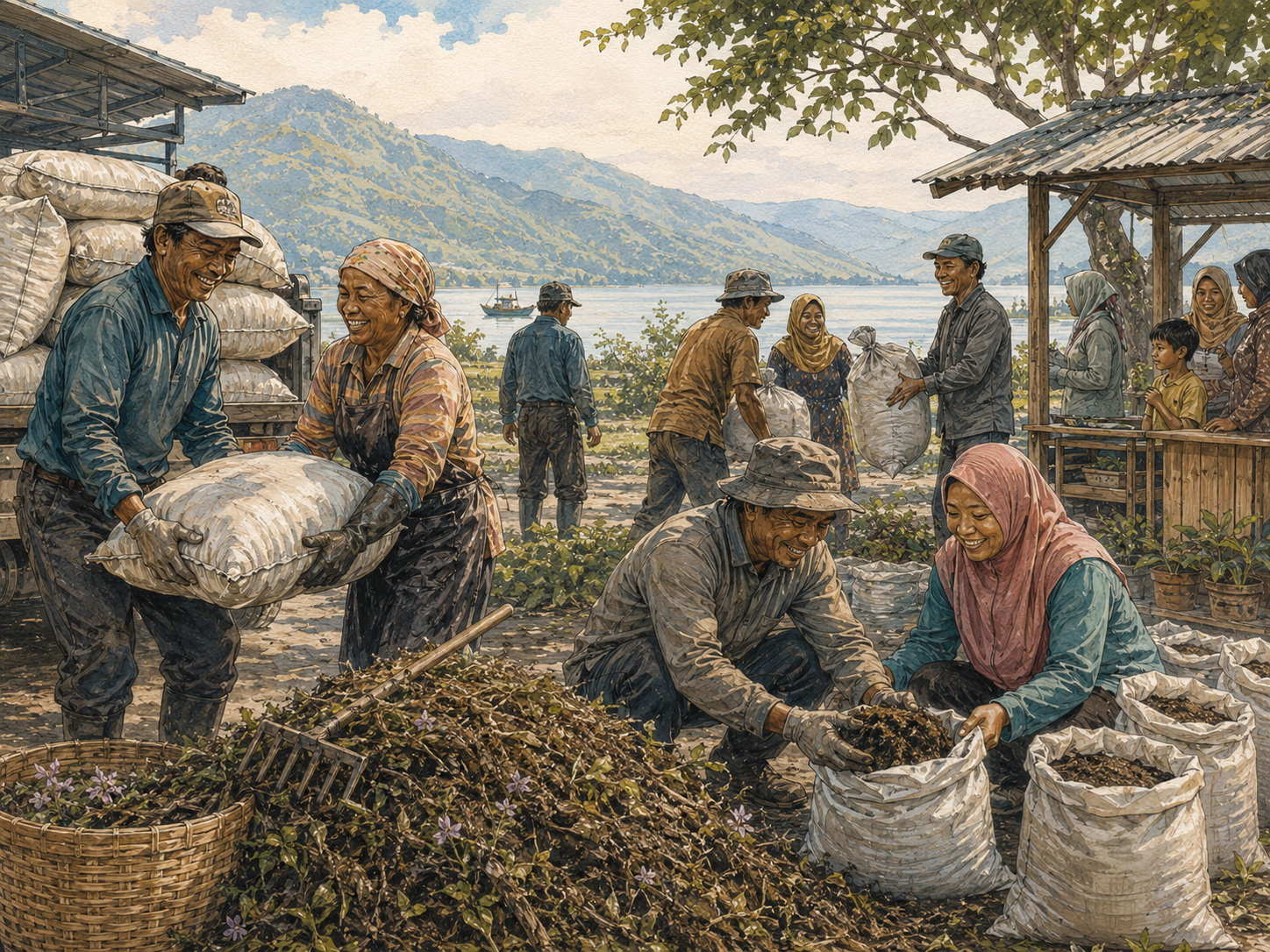
BEG’s approach is an example of a circular economy.
Instead of treating water hyacinth as useless waste, the group turns it into something valuable.
This can reduce disposal costs and help local farmers.
It may also encourage communities to participate in lake restoration because environmental action becomes connected to daily economic needs.
But there is also a danger.
If water hyacinth becomes too profitable, some people may begin to depend on its continued growth.
That would reverse the original purpose.
The economic use of water hyacinth should support eradication and ecological restoration. It should not create an industry that needs the invasive plant to survive.
The main goal must remain clear: restore the health of Lake Toba.
Dangerous Work That Often Goes Unseen
Environmental work is often praised in speeches.
But the people doing the hardest work are frequently ignored.
BEG workers spend hours pulling heavy plants from polluted water.
They lift, carry, dry, and process the plants.
The work is repetitive and physically demanding.
It receives far less attention than official meetings, ceremonies, or environmental slogans.
Yet it creates visible results.
“We love this lake,” one worker said while cleaning mud from his hands. “It is our life. We cannot just let it die.”
That sentence explains why community-led environmental movements matter.
Local communities do not protect ecosystems because the issue is fashionable.
They protect them because the lake, forest, river, or mountain is connected to their survival.
Lake Toba is their home.
What Governments Should Do
The government should not treat BEG only as a volunteer cleanup group.
It should recognize the initiative as a possible partner in a larger restoration program.
Local and national governments can support BEG by providing harvesting machines and boats, protective clothing, technical training, long-term funding, access to water-quality data, processing facilities, transportation support, and legal protection.
The government should also create measurable targets.
It is not enough to organize a meeting or launch a program.
The public should be able to see how much water hyacinth has been removed, how much pollution has been reduced, how public money has been spent, whether water quality has improved, and which institutions are responsible.
Without transparency, environmental programs can become little more than ceremonies with banners, speeches, and photographs.
The lake, rather inconveniently for bureaucrats, cannot be restored by PowerPoint.
What Universities, Businesses, and Communities Can Do
Universities can support Lake Toba restoration through applied research.
Researchers can help identify the major sources of pollution and study the safest ways to process water hyacinth.
They can also help create maps showing where the plants are spreading.
Businesses operating around Lake Toba also have a responsibility.
Hotels, restaurants, tourism operators, farms, fish farms, and other industries depend on the lake’s image and resources.
They should support its restoration through responsible waste management, financial support, equipment donations, research partnerships, and public reporting.
Communities can help by reporting new areas of water hyacinth growth and reducing waste entering the lake.
Farmers can use fertilizer more carefully. Tourism businesses can improve rubbish and wastewater management. Fishermen can report changes in water quality and fish populations.
But communities should not be blamed for problems caused by weak infrastructure, poor regulation, or uncontrolled commercial activity.
Responsibility must be shared fairly.
A Call for Collaboration
The water hyacinth problem crosses village, district, and institutional borders.
It cannot be solved by one group acting alone.
Hariara Institute calls for collaboration among local governments, national government agencies, universities, environmental organizations, communities, journalists, businesses, donors, and independent researchers.
Collaboration should not begin with slogans.
It should begin with clear roles, transparent budgets, measurable targets, and public accountability.
Lake Toba needs long-term ecological restoration, not repeated emergency cleanups.
How to Support BEG
Individuals and organizations can support BEG by sharing the initiative’s story, providing safety equipment, funding research, donating harvesting tools, supporting fertilizer testing, creating university partnerships, helping develop processing facilities, and funding long-term lake restoration.
WhatsApp: +62 821-6459-0811
Email: x2024gfm@stfx.ca
The Future of Lake Toba Is a Shared Responsibility
BEG has already shown what determination can achieve.
With only 11 workers, the initiative has cleared part of the lake, produced thousands of sacks of fertilizer, reduced farming costs, and created employment.
But the movement also reveals something uncomfortable.
If local communities must continue entering polluted water with simple tools while institutions remain slow to act, the problem is no longer only ecological.
It is political.
Lake Toba does not need more promises without measurement.
It needs cooperation, science, law enforcement, public funding, and communities placed at the center of restoration.
“Lake Toba is more than a body of water,” Lumbanbatu said. “It is a living ecosystem, a source of identity, and a home for future generations. Protecting it is not a choice. It is a responsibility.”
The green plants floating on Lake Toba may look silent.
But they are telling us something.
The lake is asking for help.
The real question is whether we will act before its warning becomes a disaster.
About the Author
Kai Ingot Damai Siallagan writes about communities, environmental challenges, and local initiatives around Lake Toba and North Sumatra. His work explores how people respond to ecological change and protect the landscapes they call home.
Tags
Lake Toba, Water Hyacinth, Eceng Gondok, Basmi Eceng Gondok, Environmental Restoration, Community Conservation, Organic Fertilizer, North Sumatra, Clean Water, Sustainable Development, Hariara Institute, Invasive Species
#LakeToba #WaterHyacinth #EcengGondok #BasmiEcengGondok #LakeTobaConservation #NorthSumatra #EnvironmentalRestoration #OrganicFertilizer #CommunityConservation #CleanWater #InvasiveSpecies #SustainableDevelopment #EnvironmentalJustice #HariaraInstitute